X Is At Most 6
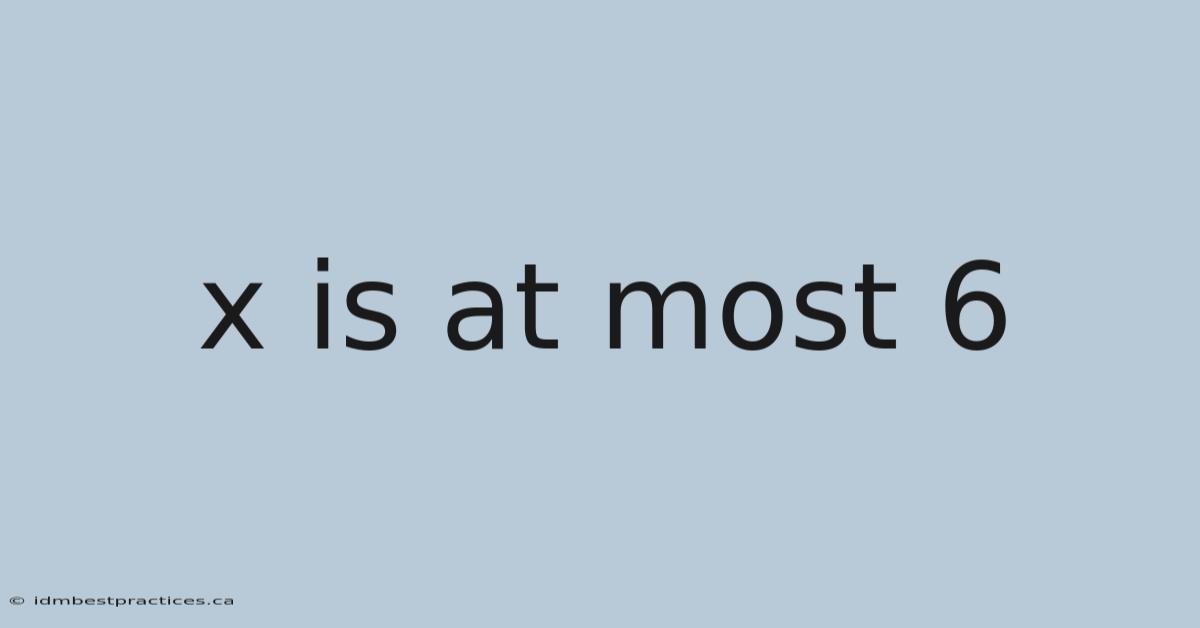
X is at Most 6: Understanding Inequalities and Their Applications
This article breaks down the mathematical concept of "x is at most 6," exploring its meaning within the framework of inequalities, showcasing its practical applications, and providing a comprehensive understanding suitable for students and anyone interested in strengthening their mathematical foundation. We'll examine how to represent this statement mathematically, solve inequalities involving this concept, and explore real-world scenarios where this type of inequality arises. Understanding this seemingly simple concept opens doors to a wider understanding of algebraic problem-solving and mathematical modeling.
Introduction: Decoding "X is at Most 6"
The statement "x is at most 6" signifies that the value of the variable x cannot exceed 6. It includes 6 itself, but x can be any value less than 6. Practically speaking, this type of statement is a classic example of a mathematical inequality. Unlike an equation, which asserts equality (=), an inequality expresses a relationship of "less than" (<), "greater than" (>), "less than or equal to" (≤), or "greater than or equal to" (≥).
x ≤ 6
This simple inequality forms the basis for numerous mathematical problems and real-world applications. Let's explore how to work with this type of inequality and its implications.
Representing Inequalities on a Number Line
Visualizing inequalities is crucial for understanding their meaning. We use a number line to graphically represent the solution set of an inequality. For x ≤ 6, we would:
- Draw a number line: Include the number 6 and numbers surrounding it.
- Mark 6: Place a closed circle (or a filled-in dot) on 6, indicating that 6 is included in the solution set.
- Shade to the left: Shade the number line to the left of 6, representing all values less than 6.
This visual representation clearly shows that the solution to x ≤ 6 includes 6 and all numbers smaller than 6.
Solving Inequalities Involving "X is at Most 6"
While the statement x ≤ 6 is straightforward, more complex inequalities might involve this concept as part of a larger problem. Let's look at examples and strategies for solving them:
Example 1: Solving a Simple Inequality
Let's say we have the inequality: 2x + 4 ≤ 16
To solve this:
- Subtract 4 from both sides: 2x ≤ 12
- Divide both sides by 2: x ≤ 6
The solution is the same as our original statement: x is at most 6.
Example 2: Inequalities with Multiple Steps
Consider a more complex inequality: 3x - 5 ≤ x + 7
- Subtract x from both sides: 2x - 5 ≤ 7
- Add 5 to both sides: 2x ≤ 12
- Divide both sides by 2: x ≤ 6
Again, we arrive at the solution x ≤ 6.
Example 3: Inequalities with Negative Coefficients
Solving inequalities with negative coefficients requires an important consideration. Remember that when you multiply or divide both sides of an inequality by a negative number, you must reverse the inequality sign.
Take this: let's solve -2x + 10 ≤ 4:
- Subtract 10 from both sides: -2x ≤ -6
- Divide both sides by -2 (and reverse the inequality sign): x ≥ 3
In this case, the solution is x is at least 3, which is different from x ≤ 6.
Real-World Applications of "X is at Most 6"
The concept of "x is at most 6" appears in numerous real-world situations. Here are a few examples:
- Weight Restrictions: A sign that reads "Maximum weight: 6 kg" indicates that the weight (x) must be less than or equal to 6 kg (x ≤ 6).
- Speed Limits: A speed limit of 60 km/h means that the speed (x) should not exceed 60 km/h (x ≤ 60).
- Capacity Limits: An elevator with a maximum capacity of 6 people indicates that the number of people (x) in the elevator should be at most 6 (x ≤ 6).
- Inventory Management: A warehouse might have a maximum storage capacity of 6 pallets for a particular item. The number of pallets (x) stored cannot exceed this limit (x ≤ 6).
- Time Constraints: A project deadline might be set for 6 PM. The completion time (x) must be at or before 6 PM (x ≤ 6 PM).
Compound Inequalities Involving "At Most 6"
If you found this helpful, you might also enjoy which term describes the red curve in the figure below or words that begin with u for preschool.
Sometimes, we encounter situations requiring compound inequalities, which combine multiple inequalities. For instance:
- 2 ≤ x ≤ 6: This means x is greater than or equal to 2 and less than or equal to 6. On a number line, this would be a shaded segment between 2 and 6, including both 2 and 6.
- x ≤ 6 and x > 0: This combines two inequalities. The solution set is all values of x greater than 0 and less than or equal to 6.
- x < 6 or x > 10: This is a different type of compound inequality using "or." The solution includes all values less than 6 or greater than 10.
Solving Compound Inequalities
Solving compound inequalities often involves solving each inequality separately and then combining the solution sets according to the connecting word ("and" or "or").
To give you an idea, let's solve the compound inequality: -2x + 8 ≤ 4 and 3x - 5 < 10
First, solve each inequality individually:
- -2x + 8 ≤ 4: -2x ≤ -4; x ≥ 2
- 3x - 5 < 10: 3x < 15; x < 5
Since the connecting word is "and", the solution is the intersection of both solution sets, meaning x must satisfy both conditions. So, the solution is 2 ≤ x < 5.
Frequently Asked Questions (FAQ)
-
Q: What's the difference between "x ≤ 6" and "x < 6"?
- A: "x ≤ 6" means x can be 6 or any value less than 6. "x < 6" means x can be any value less than 6, but not 6 itself. The difference lies in whether the boundary value (6) is included.
-
Q: How do I represent "x is at least 6" mathematically?
- A: "x is at least 6" is represented as x ≥ 6.
-
Q: Can I add or subtract the same value to both sides of an inequality without changing the solution?
- A: Yes, adding or subtracting the same value to both sides of an inequality preserves the inequality's direction.
-
Q: What about multiplying or dividing by a negative number?
- A: When multiplying or dividing both sides of an inequality by a negative number, you must reverse the inequality sign.
Conclusion: Mastering Inequalities
Understanding the concept of "x is at most 6," and more broadly, the principles of inequalities, is essential for success in mathematics and its various applications. This article has provided a detailed explanation of how to interpret, represent, and solve inequalities involving this specific concept. By grasping these fundamental concepts and practicing solving various inequality problems, you'll build a solid foundation for tackling more complex mathematical challenges in the future. But remember the key points: understand the difference between ≤ and <, know how to represent inequalities on a number line, and remember to flip the inequality sign when multiplying or dividing by a negative number. With practice and consistent effort, mastering inequalities will become second nature.
Latest Posts
Related Posts
Based on What You Read
-
Which Statement Is Always True
Aug 08, 2026
-
Which Statement Is Always True According To Vsepr Theory
Aug 08, 2026
-
Which Statement Is Always True When Describing Sex Linked Inheritance
Aug 08, 2026
-
Which Statement Is An Accurate Description Of Genes
Aug 08, 2026
-
Which Statement Is An Example Of A Central Idea
Aug 08, 2026
