X 2 7x 6 0
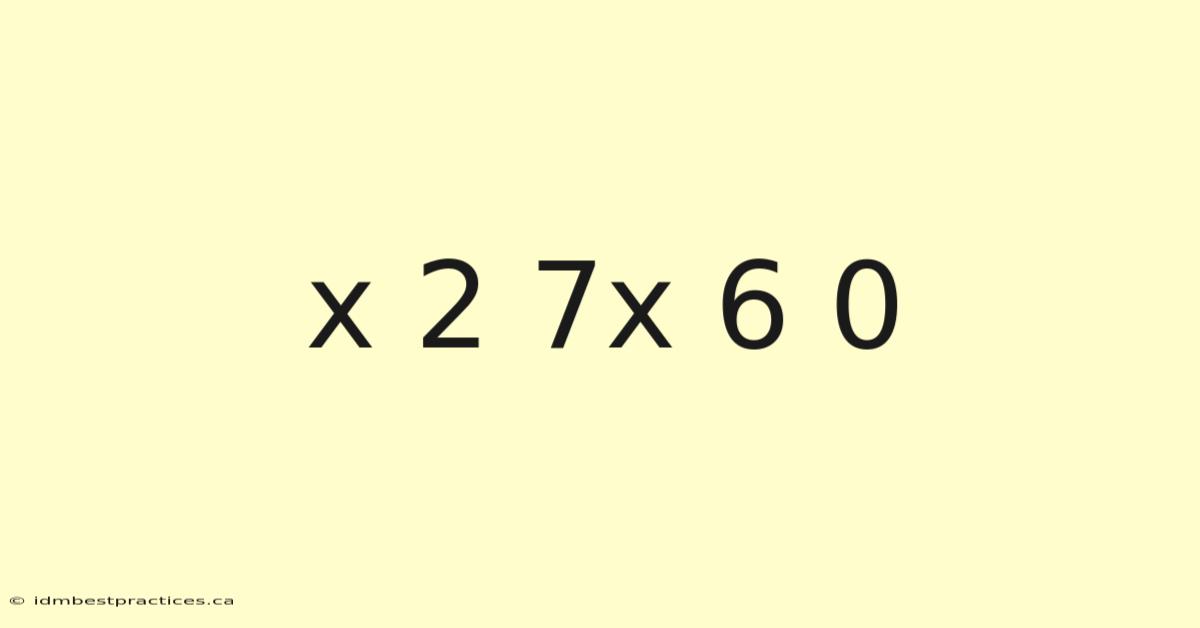
Decoding the Mystery: A Deep Dive into x² + 7x + 6 = 0
This article explores the quadratic equation x² + 7x + 6 = 0, delving into its solution through various methods and explaining the underlying mathematical concepts. We'll unpack the process step-by-step, making it accessible to anyone with a basic understanding of algebra. Understanding quadratic equations is crucial for various fields, from physics and engineering to finance and computer science. This full breakdown will not only solve the equation but also equip you with the tools to tackle similar problems with confidence.
Introduction: Understanding Quadratic Equations
A quadratic equation is a second-degree polynomial equation of the form ax² + bx + c = 0, where 'a', 'b', and 'c' are constants, and 'a' is not equal to zero. Solving this equation means finding the values of 'x' that make the equation true. Our specific equation, x² + 7x + 6 = 0, fits this form perfectly, with a = 1, b = 7, and c = 6. These values are called the roots or solutions of the equation.
There are several methods to solve quadratic equations, each with its own advantages and disadvantages. We will explore the most common techniques: factoring, using the quadratic formula, and completing the square.
Method 1: Factoring the Quadratic Equation
Factoring is a powerful technique that involves rewriting the quadratic expression as a product of two simpler expressions. This method is particularly useful when the equation has easily identifiable factors. Let's factor x² + 7x + 6 = 0:
We need to find two numbers that add up to 7 (the coefficient of 'x') and multiply to 6 (the constant term). These numbers are 1 and 6. Which means, we can rewrite the equation as:
(x + 1)(x + 6) = 0
This equation is true if either (x + 1) = 0 or (x + 6) = 0. Solving these individual equations gives us:
x + 1 = 0 => x = -1 x + 6 = 0 => x = -6
Which means, the solutions to the quadratic equation x² + 7x + 6 = 0 are x = -1 and x = -6.
Method 2: Using the Quadratic Formula
The quadratic formula is a general method that can be used to solve any quadratic equation, regardless of whether it can be easily factored. The formula is:
x = [-b ± √(b² - 4ac)] / 2a
Where 'a', 'b', and 'c' are the coefficients of the quadratic equation ax² + bx + c = 0.
For our equation, x² + 7x + 6 = 0, we have a = 1, b = 7, and c = 6. Substituting these values into the quadratic formula, we get:
x = [-7 ± √(7² - 4 * 1 * 6)] / (2 * 1) x = [-7 ± √(49 - 24)] / 2 x = [-7 ± √25] / 2 x = [-7 ± 5] / 2
This gives us two solutions:
x = (-7 + 5) / 2 = -2 / 2 = -1 x = (-7 - 5) / 2 = -12 / 2 = -6
Again, we find the solutions x = -1 and x = -6. The quadratic formula provides a reliable and reliable method for solving quadratic equations, especially those that are difficult or impossible to factor.
Method 3: Completing the Square
Completing the square is another powerful technique for solving quadratic equations. This method involves manipulating the equation to create a perfect square trinomial, which can then be easily factored. Let's apply this to our equation:
x² + 7x + 6 = 0
- Move the constant term to the right side:
x² + 7x = -6
- Take half of the coefficient of 'x' (which is 7/2), square it ((7/2)² = 49/4), and add it to both sides:
x² + 7x + 49/4 = -6 + 49/4
- Rewrite the left side as a perfect square:
(x + 7/2)² = -24/4 + 49/4 = 25/4
- Take the square root of both sides:
x + 7/2 = ±√(25/4) = ±5/2
For more on this topic, read our article on which way should fans spin in summer or check out words that have dis as a prefix.
- Solve for 'x':
x = -7/2 ± 5/2
This gives us the two solutions:
x = (-7 + 5) / 2 = -1 x = (-7 - 5) / 2 = -6
Graphical Representation and the Discriminant
The solutions of a quadratic equation can also be visualized graphically. Practically speaking, the graph of a quadratic equation is a parabola. The x-intercepts of the parabola represent the solutions (roots) of the equation. In our case, the parabola representing y = x² + 7x + 6 intersects the x-axis at x = -1 and x = -6.
The discriminant, denoted by Δ (Delta), is the expression b² - 4ac within the quadratic formula. The discriminant provides information about the nature of the roots:
- Δ > 0: The equation has two distinct real roots (as in our case).
- Δ = 0: The equation has one real root (a repeated root).
- Δ < 0: The equation has no real roots; the roots are complex numbers.
For our equation, Δ = 7² - 4(1)(6) = 25 > 0, confirming the existence of two distinct real roots.
Applications of Quadratic Equations
Quadratic equations are not merely abstract mathematical concepts; they have numerous real-world applications. Here are a few examples:
- Physics: Calculating projectile motion, determining the trajectory of an object under the influence of gravity.
- Engineering: Designing parabolic antennas, calculating the strength of structures.
- Finance: Modeling economic growth, determining investment returns.
- Computer Science: Used in algorithms and simulations.
Frequently Asked Questions (FAQ)
Q: What if the coefficient of x² is not 1?
A: All the methods described above still apply, but you might need to adjust your calculations accordingly. Day to day, for example, if you're factoring, you'll need to find factors that multiply to 'ac' and add up to 'b'. The quadratic formula works regardless of the value of 'a'.
Q: Can a quadratic equation have only one solution?
A: Yes, if the discriminant (b² - 4ac) is equal to 0, the quadratic equation has exactly one real root (a repeated root).
Q: What if the solutions are complex numbers?
A: If the discriminant is negative, the solutions will be complex numbers (involving the imaginary unit i, where i² = -1). These solutions are not directly represented as x-intercepts on a real number graph.
Q: Are there other methods to solve quadratic equations?
A: Yes, numerical methods such as the Newton-Raphson method can be used to approximate the solutions of quadratic equations, especially when analytical methods are difficult to apply.
Conclusion: Mastering Quadratic Equations
This comprehensive exploration of the quadratic equation x² + 7x + 6 = 0 has illustrated three distinct yet equally valid methods for finding its solutions: factoring, the quadratic formula, and completing the square. Day to day, understanding these methods not only allows you to solve this specific equation but also equips you with the foundational skills to tackle a wide range of quadratic equations encountered in various academic and real-world applications. Mastering quadratic equations opens doors to a deeper understanding of algebra and its diverse applications across numerous scientific and practical fields. Which means remember to consider the discriminant to understand the nature of the solutions before embarking on the solving process. Keep practicing, and you'll soon find yourself confidently solving these equations with ease.
Latest Posts
Related Posts
-
Which Statement Is Always True
Aug 08, 2026
-
Which Statement Is Always True According To Vsepr Theory
Aug 08, 2026
-
Which Statement Is Always True When Describing Sex Linked Inheritance
Aug 08, 2026
-
Which Statement Is An Accurate Description Of Genes
Aug 08, 2026
-
Which Statement Is An Example Of A Central Idea
Aug 08, 2026
