X 2 6x 11 0
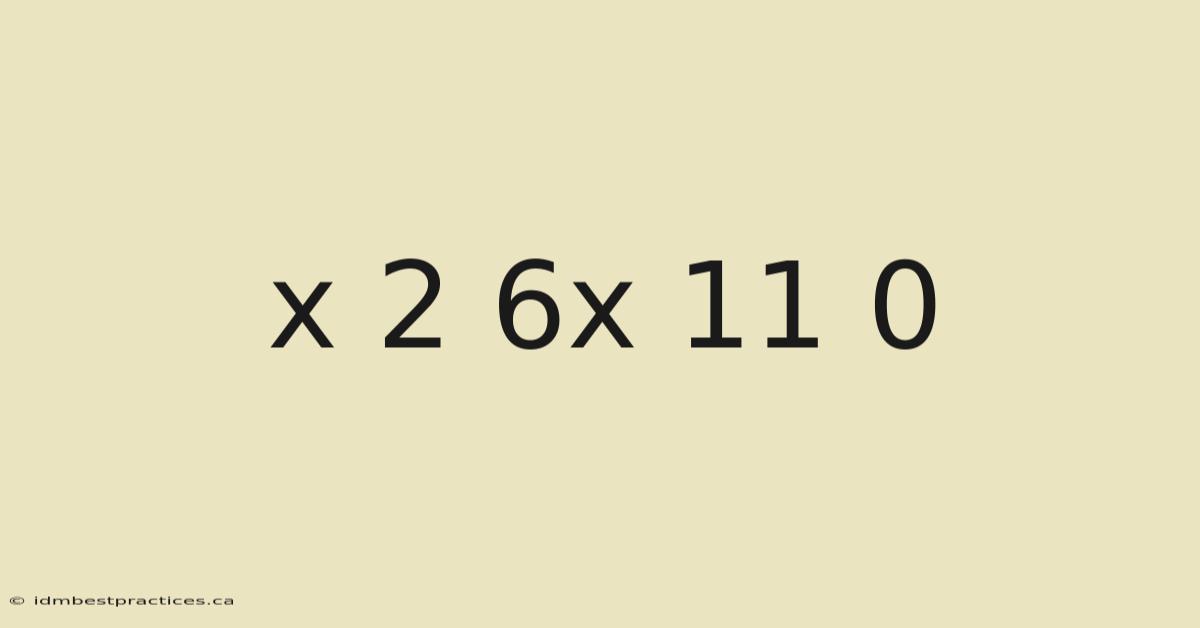
Unraveling the Mystery: A Deep Dive into the Expression x² + 6x + 11 = 0
This article explores the quadratic equation x² + 6x + 11 = 0, delving into its solution methods, the nature of its roots, and the broader mathematical concepts it exemplifies. Understanding this seemingly simple equation opens doors to a deeper comprehension of algebra and its applications. We'll cover various approaches, from the quadratic formula to completing the square, and investigate the significance of the discriminant in determining the characteristics of the solutions.
Introduction: Understanding Quadratic Equations
A quadratic equation is a polynomial equation of the second degree, meaning the highest power of the variable (usually 'x') is 2. It takes the general form ax² + bx + c = 0, where 'a', 'b', and 'c' are constants, and 'a' is not equal to zero. Our specific equation, x² + 6x + 11 = 0, fits this mold with a = 1, b = 6, and c = 11. Solving this equation means finding the values of 'x' that make the equation true. These values are called the roots or solutions of the equation. Quadratic equations can have two real roots, one real root (a repeated root), or two complex roots. The nature of the roots is determined by a key value called the discriminant.
Method 1: Using the Quadratic Formula
The quadratic formula is a powerful tool for solving any quadratic equation. It provides a direct way to calculate the roots, regardless of their nature. The formula is:
x = [-b ± √(b² - 4ac)] / 2a
Let's apply this to our equation: x² + 6x + 11 = 0. Substituting a = 1, b = 6, and c = 11, we get:
x = [-6 ± √(6² - 4 * 1 * 11)] / (2 * 1)
x = [-6 ± √(36 - 44)] / 2
x = [-6 ± √(-8)] / 2
Notice that we have a negative number under the square root. This indicates that the roots are complex numbers. We can simplify this further:
x = [-6 ± √(8)i] / 2 (where 'i' represents the imaginary unit, √(-1))
x = [-6 ± 2√(2)i] / 2
x = -3 ± √(2)i
Because of this, the solutions to the equation x² + 6x + 11 = 0 are x = -3 + √(2)i and x = -3 - √(2)i. These are complex conjugate pairs, a common characteristic of quadratic equations with a negative discriminant.
Method 2: Completing the Square
Completing the square is another method to solve quadratic equations. It involves manipulating the equation to create a perfect square trinomial, which can then be easily factored. Let's apply this method to our equation:
x² + 6x + 11 = 0
First, move the constant term to the right side:
x² + 6x = -11
Next, take half of the coefficient of the 'x' term (6/2 = 3), square it (3² = 9), and add it to both sides:
x² + 6x + 9 = -11 + 9
Now, the left side is a perfect square trinomial:
(x + 3)² = -2
Taking the square root of both sides:
x + 3 = ±√(-2)
x + 3 = ±√(2)i
Finally, solve for x:
x = -3 ± √(2)i
This yields the same complex roots as the quadratic formula, confirming our solution.
The Discriminant: Unveiling the Nature of Roots
The discriminant (b² - 4ac) is key here in determining the nature of the roots of a quadratic equation. It's the expression inside the square root in the quadratic formula.
- If b² - 4ac > 0: The equation has two distinct real roots.
- If b² - 4ac = 0: The equation has one real root (a repeated root).
- If b² - 4ac < 0: The equation has two complex roots (complex conjugates).
In our case, x² + 6x + 11 = 0, the discriminant is:
Want to learn more? We recommend you bought a magazine for $5 and four erasers and write a number in word form for further reading.
6² - 4 * 1 * 11 = 36 - 44 = -8
Since the discriminant is negative, we confirmed that the equation has two complex roots, as calculated using both the quadratic formula and completing the square.
Graphical Representation and Interpretation
The graph of a quadratic equation is a parabola. Which means the parabola opens upwards (because a = 1 > 0) and lies entirely above the x-axis. Plus, since our equation has complex roots, its parabola does not intersect the x-axis. Practically speaking, the x-intercepts of the parabola represent the real roots of the equation. This visual representation reinforces the fact that there are no real solutions; the roots are imaginary.
Expanding the Understanding: Complex Numbers
The appearance of complex numbers in our solutions highlights their importance in mathematics. In practice, complex numbers are numbers of the form a + bi, where 'a' and 'b' are real numbers, and 'i' is the imaginary unit (√(-1)). They extend the number system beyond real numbers, allowing us to solve equations that have no real solutions. Complex numbers have wide applications in various fields, including electrical engineering, quantum mechanics, and signal processing.
Applications of Quadratic Equations
Quadratic equations are fundamental in many areas of mathematics and science. They are used to model:
- Projectile motion: The trajectory of a projectile, like a ball thrown in the air, can be described by a quadratic equation.
- Area and volume problems: Calculations involving areas of rectangles or volumes of containers often involve solving quadratic equations.
- Optimization problems: Finding maximum or minimum values (e.g., maximizing profit or minimizing cost) often requires solving quadratic equations.
- Physics and engineering: Quadratic equations appear in many physics and engineering problems involving forces, motion, and energy.
Frequently Asked Questions (FAQ)
-
Q: Why are the complex roots always conjugates?
- A: The quadratic formula inherently produces conjugate pairs when the discriminant is negative. The ± symbol in the formula leads to two roots that are mirror images of each other across the real axis in the complex plane.
-
Q: Can a quadratic equation have only one complex root?
- A: No. Complex roots of quadratic equations always come in conjugate pairs.
-
Q: What does it mean if the parabola is entirely above the x-axis?
- A: It means the quadratic equation has no real roots; all its roots are complex.
-
Q: Are there other methods to solve quadratic equations besides the quadratic formula and completing the square?
- A: Yes, factoring is another common method, but it's not always applicable. Numerical methods can also be used to approximate the roots when factoring or the quadratic formula are impractical.
Conclusion: The Significance of x² + 6x + 11 = 0
Although seemingly simple, the equation x² + 6x + 11 = 0 provides a valuable platform for exploring key concepts in algebra. And understanding the different methods for solving quadratic equations, their graphical representations, and their wide-ranging applications reinforces a strong foundation in mathematics, essential for success in higher-level studies and various scientific and engineering disciplines. Consider this: its solution reveals the nature of complex numbers and demonstrates the importance of the discriminant in characterizing the roots of a quadratic equation. The equation serves as a microcosm of the elegance and power of mathematical concepts, highlighting how seemingly simple expressions can access profound insights into the world around us.
Latest Posts
Related Posts
Follow the Thread
-
Which Statement Is Always True
Aug 08, 2026
-
Which Statement Is Always True According To Vsepr Theory
Aug 08, 2026
-
Which Statement Is Always True When Describing Sex Linked Inheritance
Aug 08, 2026
-
Which Statement Is An Accurate Description Of Genes
Aug 08, 2026
-
Which Statement Is An Example Of A Central Idea
Aug 08, 2026
