X 2 6 X 2
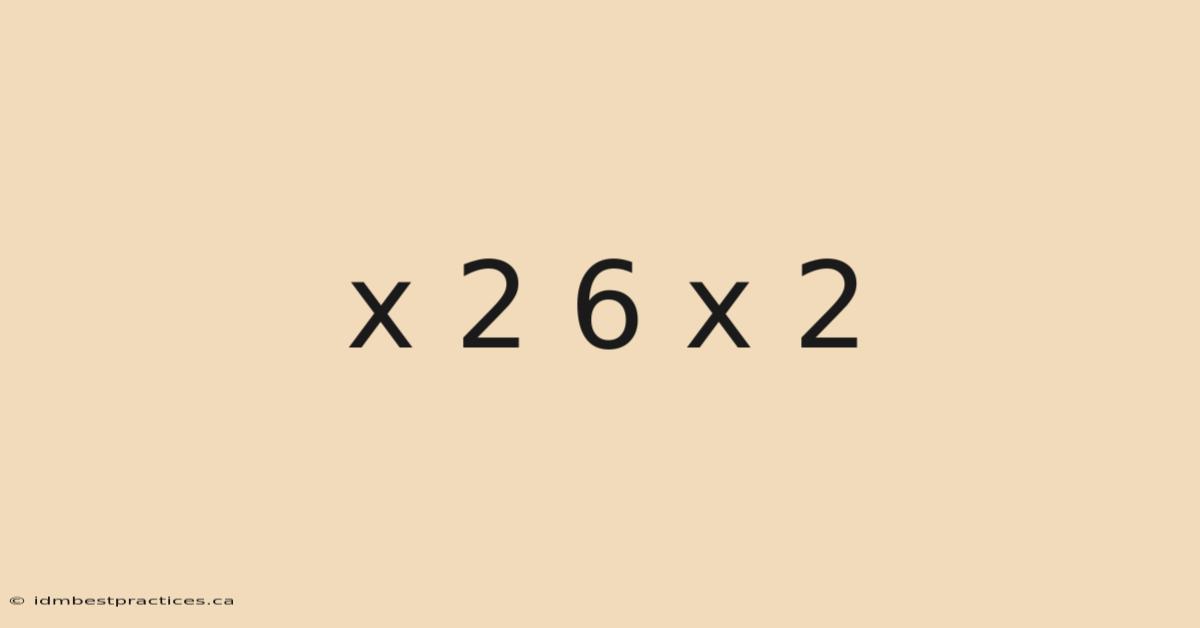
Decoding the Enigma: A Deep Dive into x² + 6x + 2
The seemingly simple quadratic expression, x² + 6x + 2, hides a wealth of mathematical concepts within its concise form. This seemingly innocuous equation opens doors to understanding fundamental algebraic principles, powerful solution methods, and even the deeper connections between algebra and geometry. This article will serve as a practical guide, exploring this quadratic expression from its basic properties to its advanced applications, ensuring a thorough understanding for students and enthusiasts alike.
Introduction: Understanding Quadratic Equations
Before diving into the specifics of x² + 6x + 2, let's establish a foundational understanding of quadratic equations. A quadratic equation is a polynomial equation of the second degree, meaning the highest power of the variable (in this case, 'x') is 2. The general form is ax² + bx + c = 0, where 'a', 'b', and 'c' are constants, and 'a' is not equal to zero (otherwise, it wouldn't be a quadratic). Our expression, x² + 6x + 2, represents a quadratic function (as it's not set equal to zero), and understanding its properties is crucial to solving related equations.
1. Solving the Quadratic Equation x² + 6x + 2 = 0
To solve the quadratic equation x² + 6x + 2 = 0, we have several methods at our disposal. Let's explore the most common ones:
-
Factoring: This method involves expressing the quadratic as a product of two linear factors. Unfortunately, x² + 6x + 2 doesn't factor neatly using integers. This means we need to employ other techniques.
-
Quadratic Formula: This is a universal method for solving any quadratic equation. The formula is derived from completing the square and provides the solutions directly. For the general equation ax² + bx + c = 0, the solutions are given by:
x = (-b ± √(b² - 4ac)) / 2a
In our case, a = 1, b = 6, and c = 2. Substituting these values into the quadratic formula yields:
x = (-6 ± √(6² - 4 * 1 * 2)) / (2 * 1) x = (-6 ± √(36 - 8)) / 2 x = (-6 ± √28) / 2 x = (-6 ± 2√7) / 2 x = -3 ± √7
Because of this, the solutions to the equation x² + 6x + 2 = 0 are x = -3 + √7 and x = -3 - √7. These are irrational solutions, meaning they cannot be expressed as simple fractions.
-
Completing the Square: This method involves manipulating the equation to create a perfect square trinomial. Let's demonstrate:
x² + 6x + 2 = 0 x² + 6x = -2 x² + 6x + 9 = -2 + 9 (Adding 9, which is (6/2)²) (x + 3)² = 7 x + 3 = ±√7 x = -3 ± √7
This method confirms the solutions obtained using the quadratic formula.
2. Analyzing the Quadratic Function: x² + 6x + 2
Now, let's analyze the quadratic function itself, f(x) = x² + 6x + 2. Understanding its properties provides deeper insights:
-
Vertex: The vertex represents the minimum or maximum point of the parabola. For a quadratic function in the form f(x) = ax² + bx + c, the x-coordinate of the vertex is given by -b/2a. In our case:
x = -6 / (2 * 1) = -3
To find the y-coordinate, substitute x = -3 into the function:
f(-3) = (-3)² + 6(-3) + 2 = 9 - 18 + 2 = -7
Which means, the vertex of the parabola is (-3, -7). Since 'a' (the coefficient of x²) is positive, this parabola opens upwards, indicating a minimum value.
-
Axis of Symmetry: The axis of symmetry is a vertical line that passes through the vertex, dividing the parabola into two symmetrical halves. Its equation is x = -3.
-
x-intercepts (Roots): These are the points where the parabola intersects the x-axis, i.e., where f(x) = 0. We already found these in the previous section: x = -3 + √7 and x = -3 - √7.
-
y-intercept: This is the point where the parabola intersects the y-axis, which occurs when x = 0. Substituting x = 0 into the function:
f(0) = 0² + 6(0) + 2 = 2
The y-intercept is (0, 2).
-
Domain and Range: The domain of a quadratic function is all real numbers (-∞, ∞). The range, however, is restricted by the vertex. Since the parabola opens upwards and has a minimum value of -7, the range is [-7, ∞).
3. Graphical Representation
Plotting the vertex, intercepts, and a few additional points, we can accurately sketch the graph of the quadratic function. The parabola will be a U-shaped curve opening upwards, symmetric about the line x = -3, with a minimum point at (-3, -7). This visual representation further solidifies our understanding of the function's behavior.
If you found this helpful, you might also enjoy x 1 2 1 x or who ran for president in 1924.
4. Applications of Quadratic Equations
Quadratic equations have numerous applications in various fields:
-
Physics: Calculating projectile motion, determining the trajectory of objects under the influence of gravity.
-
Engineering: Designing structures, optimizing shapes and sizes for maximum efficiency.
-
Economics: Modeling supply and demand, analyzing market trends.
-
Computer Graphics: Creating curved lines and shapes.
Our specific quadratic, x² + 6x + 2, might represent a simplified model of a parabolic curve in any of these scenarios, illustrating the practical relevance of understanding its properties.
5. Exploring Further: Discriminant and Nature of Roots
The expression b² - 4ac within the quadratic formula is called the discriminant. It provides valuable information about the nature of the roots:
-
b² - 4ac > 0: The quadratic equation has two distinct real roots (as in our case).
-
b² - 4ac = 0: The quadratic equation has one real root (a repeated root).
-
b² - 4ac < 0: The quadratic equation has no real roots; the roots are complex conjugates (involving imaginary numbers).
In our example, the discriminant is 36 - 8 = 28, which is positive, confirming the two distinct real roots we found.
6. Advanced Topics: Calculus and Quadratic Functions
For those familiar with calculus, analyzing the quadratic function through its derivative and second derivative provides further insights:
-
First Derivative: f'(x) = 2x + 6. Setting this to zero gives the critical point x = -3, which corresponds to the x-coordinate of the vertex. The first derivative helps determine the slope of the tangent line at any point on the curve.
-
Second Derivative: f''(x) = 2. Since the second derivative is positive, it confirms that the parabola is concave upwards (opens upwards).
7. Frequently Asked Questions (FAQ)
-
Q: What are the roots of x² + 6x + 2 = 0?
- A: The roots are x = -3 + √7 and x = -3 - √7.
-
Q: How do I find the vertex of the parabola represented by x² + 6x + 2?
- A: The vertex is found using the formula -b/2a for the x-coordinate and then substituting this value back into the function to find the y-coordinate. In this case, the vertex is (-3, -7).
-
Q: What is the axis of symmetry of the parabola?
- A: The axis of symmetry is a vertical line passing through the vertex. Its equation is x = -3.
-
Q: Can this quadratic equation be solved by factoring?
- A: No, this particular quadratic equation does not factor neatly using integers. The quadratic formula or completing the square are more appropriate methods.
8. Conclusion: A Deeper Appreciation of Quadratics
This comprehensive exploration of x² + 6x + 2 reveals that even a seemingly simple quadratic expression holds considerable mathematical depth. From its solutions and graphical representation to its applications and advanced analysis, understanding this equation provides a strong foundation for tackling more complex mathematical concepts. By mastering the techniques discussed here, you will gain a far deeper appreciation for the power and elegance of quadratic equations and their role in various fields of study. Remember, the journey of understanding mathematics is continuous, and each seemingly simple equation holds a universe of knowledge waiting to be discovered.
Latest Posts
Related Posts
Same Topic, More Views
-
Which Statement Is Always True
Aug 08, 2026
-
Which Statement Is Always True According To Vsepr Theory
Aug 08, 2026
-
Which Statement Is Always True When Describing Sex Linked Inheritance
Aug 08, 2026
-
Which Statement Is An Accurate Description Of Genes
Aug 08, 2026
-
Which Statement Is An Example Of A Central Idea
Aug 08, 2026
