X 2 2x 1 0
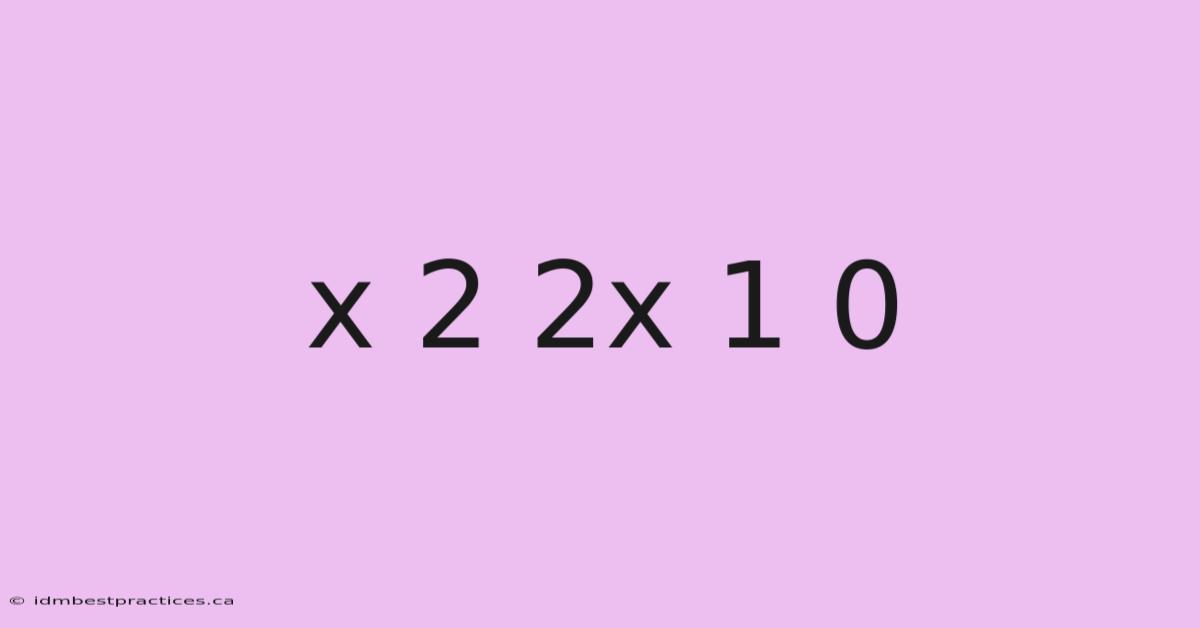
Decoding the Enigma: A Deep Dive into x² - 2x + 1 = 0
The seemingly simple quadratic equation, x² - 2x + 1 = 0, holds a wealth of mathematical concepts within its concise form. This equation serves as a fundamental building block for understanding more complex algebraic concepts, and its solution offers insights into factoring, completing the square, and the quadratic formula. This article will not only solve the equation but also explore the underlying mathematical principles, providing a comprehensive understanding suitable for students and anyone interested in brushing up on their algebra skills.
Understanding Quadratic Equations
Before diving into the solution, let's establish a foundational understanding of quadratic equations. A quadratic equation is a polynomial equation of the second degree, meaning the highest power of the variable (in this case, x) is 2. The general form of a quadratic equation is ax² + bx + c = 0, where a, b, and c are constants, and a ≠ 0 (if a were 0, it wouldn't be a quadratic equation). In our specific equation, x² - 2x + 1 = 0, we have a = 1, b = -2, and c = 1.
Method 1: Factoring
Factoring is a powerful technique for solving quadratic equations. It involves expressing the quadratic expression as a product of two simpler expressions. But our equation, x² - 2x + 1 = 0, is a perfect square trinomial. This means it can be factored into the square of a binomial.
(x - 1)(x - 1) = x² - x - x + 1 = x² - 2x + 1
Which means, our equation can be rewritten as:
(x - 1)² = 0
Taking the square root of both sides, we get:
x - 1 = 0
Solving for x, we find:
x = 1
This indicates that the equation has a single, repeated root (or solution) at x = 1. This is a characteristic of perfect square trinomials; they possess only one distinct solution.
Method 2: Completing the Square
Completing the square is another valuable method for solving quadratic equations. This technique involves manipulating the equation to create a perfect square trinomial, allowing for easier factoring and solution. Let's apply this method to our equation:
x² - 2x + 1 = 0
Notice that the left-hand side is already a perfect square trinomial. Even so, let's demonstrate the process:
- Move the constant term to the right side:
x² - 2x = -1
- Take half of the coefficient of the x term (-2), square it ((-1)² = 1), and add it to both sides:
x² - 2x + 1 = -1 + 1
- Factor the left side as a perfect square:
(x - 1)² = 0
- Solve for x as before:
x - 1 = 0 => x = 1
Again, we arrive at the same solution: x = 1. This reinforces the fact that our equation has a single, repeated root.
Method 3: The Quadratic Formula
The quadratic formula is a universal tool for solving any quadratic equation, regardless of its factorability. It's derived from completing the square and provides a direct route to the solutions. The formula is:
x = [-b ± √(b² - 4ac)] / 2a
For our equation, x² - 2x + 1 = 0, we have a = 1, b = -2, and c = 1. Substituting these values into the quadratic formula:
x = [-(-2) ± √((-2)² - 4 * 1 * 1)] / (2 * 1)
x = [2 ± √(4 - 4)] / 2
x = [2 ± √0] / 2
x = 2 / 2
x = 1
Once more, we obtain the solution x = 1. The quadratic formula confirms the single, repeated root.
Graphical Representation and the Discriminant
The graphical representation of the equation y = x² - 2x + 1 is a parabola. The solution to the equation x² - 2x + 1 = 0 corresponds to the x-intercept(s) of this parabola. Since we have only one solution (x = 1), the parabola touches the x-axis at only one point – the vertex of the parabola.
For more on this topic, read our article on x intercept of tangent line or check out words to describe a desert.
The discriminant, represented by the expression b² - 4ac within the quadratic formula, provides crucial information about the nature of the roots.
- If b² - 4ac > 0: The equation has two distinct real roots. The parabola intersects the x-axis at two different points.
- If b² - 4ac = 0: The equation has one repeated real root (a single solution). The parabola touches the x-axis at only one point (its vertex).
- If b² - 4ac < 0: The equation has no real roots. The parabola does not intersect the x-axis.
In our case, b² - 4ac = (-2)² - 4(1)(1) = 0, confirming the single repeated root at x = 1.
Exploring the Significance of Repeated Roots
The fact that x² - 2x + 1 = 0 has a repeated root highlights its special nature. In real terms, this is not merely a coincidence; it signifies the equation represents a perfect square. Think about it: the repeated root indicates a point of tangency between the parabola and the x-axis. The parabola doesn't cross the x-axis; it just touches it at its vertex. This is visually significant and conceptually important in understanding the behavior of quadratic functions.
Repeated roots frequently appear in various mathematical applications, particularly in areas like calculus (when finding critical points), physics (in certain oscillatory systems), and engineering (in analyzing stability).
Applications of Quadratic Equations
Quadratic equations are far from being theoretical constructs. They have extensive applications across numerous fields, including:
- Physics: Calculating projectile motion, determining the trajectory of objects under gravity.
- Engineering: Designing bridges, structures, and optimizing various systems.
- Economics: Modeling supply and demand curves, analyzing market equilibrium.
- Computer Science: Developing algorithms and solving optimization problems.
Frequently Asked Questions (FAQ)
Q: Can I solve this equation using only one method?
A: While you can solve this specific equation using any of the methods (factoring, completing the square, or the quadratic formula), understanding all three provides a deeper appreciation of the underlying mathematical principles and enhances your problem-solving skills.
Q: What if the equation wasn't a perfect square trinomial?
A: If the equation wasn't a perfect square trinomial, you could still use completing the square or the quadratic formula to find the solutions. Factoring might become more challenging or impossible depending on the nature of the roots.
Q: What does the graph of this equation look like?
A: The graph of y = x² - 2x + 1 is a parabola that opens upwards. Its vertex is located at the point (1,0), and it is tangent to the x-axis at this point.
Q: Why is it important to understand quadratic equations?
A: Quadratic equations are foundational to algebra and have numerous applications in various fields, making them essential for a strong mathematical understanding.
Conclusion
The seemingly simple equation x² - 2x + 1 = 0 provides a rich learning experience, encompassing fundamental algebraic techniques and revealing deeper mathematical concepts. Through factoring, completing the square, and the quadratic formula, we've demonstrated the multiple approaches to solving this quadratic equation and highlighted the significance of its single, repeated root. Understanding this equation is not just about finding the solution; it's about grasping the underlying principles that govern quadratic equations and their widespread applications in various fields of study and real-world problems. By mastering the techniques used in solving this seemingly straightforward equation, you build a solid foundation for tackling more complex mathematical challenges.
Latest Posts
Related Posts
See More Like This
-
Which Statement Is Always True
Aug 08, 2026
-
Which Statement Is Always True According To Vsepr Theory
Aug 08, 2026
-
Which Statement Is Always True When Describing Sex Linked Inheritance
Aug 08, 2026
-
Which Statement Is An Accurate Description Of Genes
Aug 08, 2026
-
Which Statement Is An Example Of A Central Idea
Aug 08, 2026
