X 2 11x 18 0
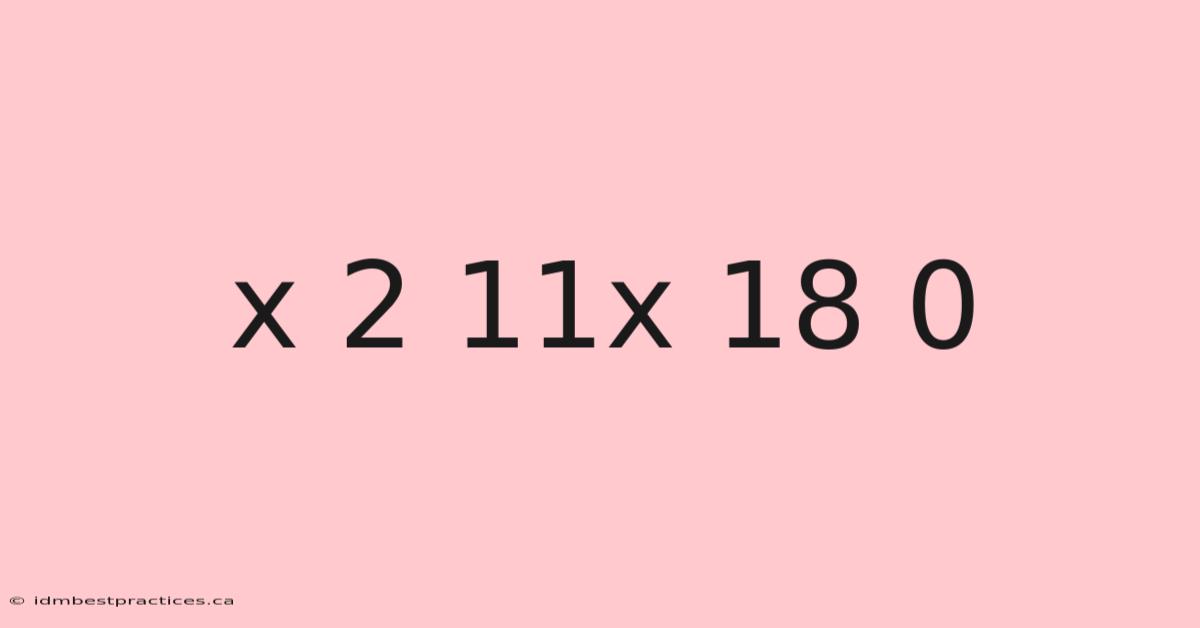
Deconstructing the Equation: x² + 11x + 18 = 0
This article gets into the solution and underlying principles of the quadratic equation x² + 11x + 18 = 0. We'll explore multiple methods for solving this equation, examine the underlying mathematical concepts, and provide a comprehensive understanding suitable for students and anyone interested in strengthening their algebra skills. Understanding quadratic equations is fundamental to advanced mathematical concepts and has practical applications across various fields. This guide will empower you with the knowledge to tackle similar problems with confidence.
Introduction to Quadratic Equations
A quadratic equation is a polynomial equation of the second degree, meaning the highest power of the variable (usually x) is 2. It generally takes the form ax² + bx + c = 0, where a, b, and c are constants, and a is not equal to zero. But our specific equation, x² + 11x + 18 = 0, fits this general form with a = 1, b = 11, and c = 18. Solving a quadratic equation means finding the values of x that satisfy the equation—that is, the values of x that make the equation true.
Method 1: Factoring the Quadratic Equation
Factoring is a common and often the easiest method for solving quadratic equations, particularly when the factors are relatively simple to identify. This method involves rewriting the equation as a product of two binomials. Let's apply this to our equation:
x² + 11x + 18 = 0
We need to find two numbers that add up to 11 (the coefficient of x) and multiply to 18 (the constant term). These numbers are 2 and 9. Because of this, we can factor the equation as follows:
(x + 2)(x + 9) = 0
This equation is true if either (x + 2) = 0 or (x + 9) = 0. Solving these simple linear equations gives us the solutions:
x + 2 = 0 => x = -2 x + 9 = 0 => x = -9
So, the solutions to the quadratic equation x² + 11x + 18 = 0 are x = -2 and x = -9.
Method 2: Using the Quadratic Formula
The quadratic formula is a powerful tool that can be used to solve any quadratic equation, regardless of whether it's easily factorable. The formula is derived from completing the square and is given by:
x = [-b ± √(b² - 4ac)] / 2a
Let's apply this formula to our equation, where a = 1, b = 11, and c = 18:
x = [-11 ± √(11² - 4 * 1 * 18)] / (2 * 1) x = [-11 ± √(121 - 72)] / 2 x = [-11 ± √49] / 2 x = [-11 ± 7] / 2
This gives us two solutions:
x = (-11 + 7) / 2 = -4 / 2 = -2 x = (-11 - 7) / 2 = -18 / 2 = -9
Again, we arrive at the solutions x = -2 and x = -9, confirming the results obtained through factoring.
Method 3: Completing the Square
Completing the square is another algebraic technique used to solve quadratic equations. This method involves manipulating the equation to create a perfect square trinomial, which can then be easily factored.
Let's apply this method to x² + 11x + 18 = 0:
-
Move the constant term to the right side: x² + 11x = -18
-
Take half of the coefficient of x (11/2 = 5.5), square it (5.5² = 30.25), and add it to both sides: x² + 11x + 30.25 = -18 + 30.25 x² + 11x + 30.25 = 12.25
-
Factor the left side as a perfect square: (x + 5.5)² = 12.25
-
Take the square root of both sides: x + 5.5 = ±√12.25 x + 5.5 = ±3.5
-
Solve for x: x = -5.5 + 3.5 = -2 x = -5.5 - 3.5 = -9
For more on this topic, read our article on why is a cooling system pressurized or check out why is it important for managers to study history.
Once again, we obtain the solutions x = -2 and x = -9.
Graphical Representation and the Discriminant
The solutions to a quadratic equation represent the x-intercepts (points where the graph intersects the x-axis) of the parabola represented by the equation y = x² + 11x + 18. The graph of this equation is a parabola that opens upwards (since the coefficient of x² is positive). The x-intercepts are at x = -2 and x = -9.
The discriminant, b² - 4ac, provides valuable information about the nature of the solutions:
- b² - 4ac > 0: Two distinct real solutions (as in our case).
- b² - 4ac = 0: One real solution (a repeated root).
- b² - 4ac < 0: Two complex solutions (involving imaginary numbers).
In our equation, the discriminant is 11² - 4(1)(18) = 49, which is greater than 0, indicating two distinct real solutions.
Practical Applications of Quadratic Equations
Quadratic equations are not merely abstract mathematical concepts; they have wide-ranging practical applications in various fields, including:
- Physics: Calculating projectile motion, determining the trajectory of objects under the influence of gravity.
- Engineering: Designing structures, analyzing stresses and strains in materials, modeling electrical circuits.
- Economics: Modeling supply and demand curves, optimizing production levels, calculating profit margins.
- Computer Graphics: Creating curved shapes and animation paths.
Frequently Asked Questions (FAQs)
Q: What does it mean to "solve" a quadratic equation?
A: Solving a quadratic equation means finding the values of the variable (x in this case) that make the equation true. These values are called the roots or solutions of the equation.
Q: Can a quadratic equation have more than two solutions?
A: No, a quadratic equation can have at most two solutions. These solutions can be real numbers, or they can be complex numbers (involving the imaginary unit i).
Q: What if I can't factor the quadratic equation easily?
A: If factoring is difficult or impossible, you can always use the quadratic formula or complete the square to find the solutions.
Q: What is the significance of the discriminant?
A: The discriminant tells us the nature of the solutions to the quadratic equation. A positive discriminant indicates two distinct real solutions, a zero discriminant indicates one repeated real solution, and a negative discriminant indicates two complex solutions.
Q: Are there other methods to solve quadratic equations besides the ones mentioned?
A: Yes, there are other less common methods like using graphical analysis or iterative numerical methods, but the methods described above are the most commonly used and readily applicable.
Conclusion
Solving the quadratic equation x² + 11x + 18 = 0 has demonstrated the application of several crucial algebraic techniques. Understanding these methods not only allows you to solve this specific equation but also equips you to confidently tackle a wide range of similar problems. Now, factoring, the quadratic formula, and completing the square are all valuable tools in your mathematical arsenal. And the ability to solve quadratic equations is a cornerstone of further mathematical studies and has significant real-world applications across numerous disciplines. Also, remember, the choice of method often depends on the specific characteristics of the equation. By mastering these techniques, you're not just learning algebra; you're building a foundation for success in many future endeavors.
Latest Posts
Related Posts
You Might Also Like
-
Which Statement Is Always True
Aug 08, 2026
-
Which Statement Is Always True According To Vsepr Theory
Aug 08, 2026
-
Which Statement Is Always True When Describing Sex Linked Inheritance
Aug 08, 2026
-
Which Statement Is An Accurate Description Of Genes
Aug 08, 2026
-
Which Statement Is An Example Of A Central Idea
Aug 08, 2026
