V 2 U 2 2as
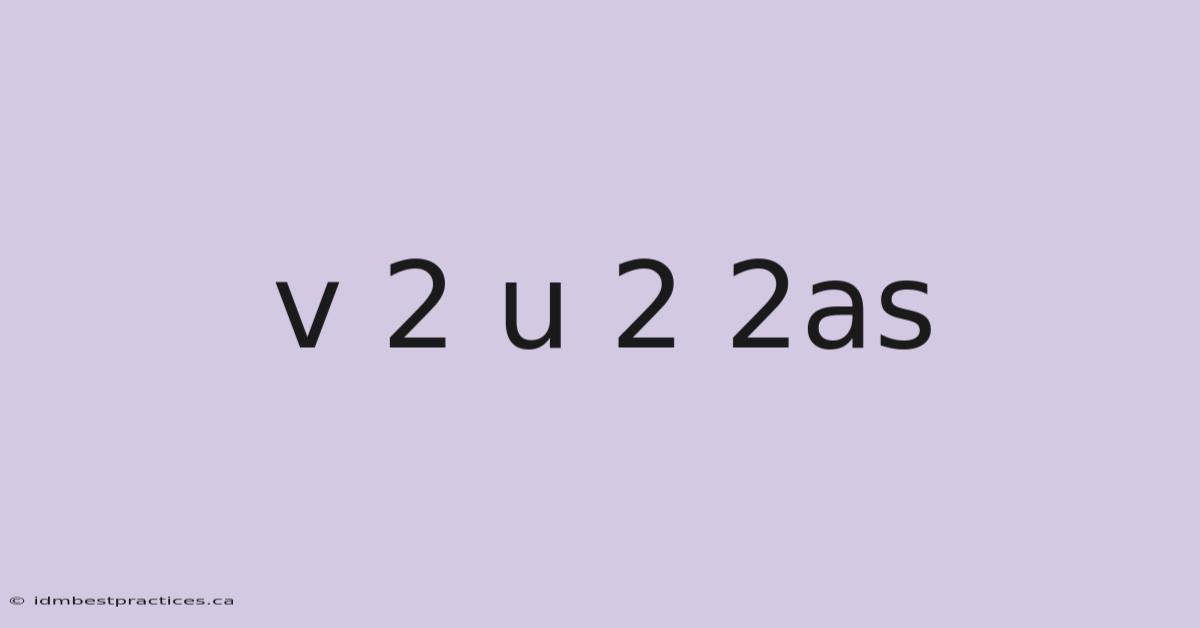
Understanding V^2 = U^2 + 2as: A Deep Dive into Equations of Motion
This article provides a comprehensive explanation of the equation V² = U² + 2as, a fundamental concept in kinematics. We'll explore its derivation, applications, and practical implications, demystifying this crucial equation for students and enthusiasts alike. Plus, understanding this equation is key to mastering the basics of motion and its applications in various fields of physics and engineering. We'll cover everything from the meaning of each variable to solving complex problems using this powerful tool.
Introduction: What does V² = U² + 2as represent?
The equation V² = U² + 2as is one of the three equations of motion used to describe the motion of an object moving with constant acceleration. It relates the final velocity (V) of an object to its initial velocity (U), acceleration (a), and displacement (s). This equation is particularly useful when we don't know the time taken for the motion.
-
V: Represents the final velocity of the object. This is the velocity the object has reached at the end of the considered time interval. It is usually measured in meters per second (m/s).
-
U: Represents the initial velocity of the object. This is the velocity the object had at the beginning of the considered time interval. It is also measured in meters per second (m/s).
-
a: Represents the acceleration of the object. This is the rate at which the object's velocity changes. Acceleration is measured in meters per second squared (m/s²). A positive value indicates acceleration (speeding up), while a negative value indicates deceleration or retardation (slowing down).
-
s: Represents the displacement of the object. This is the change in the object's position from its starting point to its ending point. It's a vector quantity, meaning it has both magnitude and direction. Displacement is measured in meters (m).
Deriving the Equation: A Step-by-Step Approach
The equation V² = U² + 2as can be derived from the other two equations of motion:
-
v = u + at: This equation relates final velocity (v), initial velocity (u), acceleration (a), and time (t).
-
s = ut + ½at²: This equation relates displacement (s), initial velocity (u), acceleration (a), and time (t).
To derive V² = U² + 2as, we can follow these steps:
-
Solve for t in the first equation: Rearranging v = u + at, we get t = (v - u)/a.
-
Substitute this value of t into the second equation: Replacing t in s = ut + ½at² with (v - u)/a, we obtain:
s = u[(v - u)/a] + ½a[(v - u)/a]²
-
Simplify the equation: Expanding and simplifying the equation, we get:
s = (uv - u²)/a + ½a(v² - 2uv + u²)/a²
s = (uv - u²)/a + (v² - 2uv + u²)/(2a)
-
Further simplification: Multiplying both sides by 2a to eliminate the fractions:
2as = 2uv - 2u² + v² - 2uv + u²
-
Combine like terms: This simplifies to:
2as = v² - u²
-
Rearrange to obtain the final equation: Finally, rearranging the equation, we arrive at:
V² = U² + 2as
Applying the Equation: Solving Problems
Let's illustrate the use of V² = U² + 2as with a few examples:
Example 1: Calculating Final Velocity
A car accelerates uniformly from rest (U = 0 m/s) to a final velocity (V) over a distance of 100 meters (s) with an acceleration of 5 m/s² (a). Find the final velocity (V).
Using V² = U² + 2as:
V² = 0² + 2 * 5 m/s² * 100 m V² = 1000 m²/s² V = √1000 m²/s² V ≈ 31.6 m/s
That's why, the final velocity of the car is approximately 31.6 m/s.
Want to learn more? We recommend writing inequalities with variables on both sides and why does mitochondria have a double membrane for further reading.
Example 2: Calculating Acceleration
A train traveling at 20 m/s (U) decelerates uniformly to a stop (V = 0 m/s) over a distance of 500 meters (s). Calculate the deceleration (a). Note that deceleration is negative acceleration.
Using V² = U² + 2as:
0² = 20² + 2 * a * 500 -400 = 1000a a = -400/1000 a = -0.4 m/s²
The train's deceleration is 0.4 m/s².
Example 3: Calculating Displacement
A ball is thrown vertically upwards with an initial velocity of 15 m/s (U). Calculate the maximum height reached by the ball (s). Because of that, the acceleration due to gravity is -9. This leads to 8 m/s² (a). At the maximum height, the final velocity (V) is 0 m/s.
Using V² = U² + 2as:
0² = 15² + 2 * (-9.Now, 8 m/s²) * s 0 = 225 - 19. And 6s 19. 6s = 225 s ≈ 11.
The maximum height reached by the ball is approximately 11.48 meters.
Limitations of V² = U² + 2as
It's crucial to remember that this equation applies only under specific conditions:
-
Constant acceleration: The acceleration of the object must remain constant throughout the motion. This equation doesn't apply to situations involving variable acceleration.
-
Straight-line motion: The equation describes motion in a straight line. It cannot be directly applied to curvilinear motion (motion along a curved path).
Further Exploration: Connecting with Other Equations of Motion
V² = U² + 2as is part of a family of three equations of motion that describe uniformly accelerated motion. Understanding the relationships between these equations allows for more flexible problem-solving:
-
v = u + at: Useful when time (t) is involved.
-
s = ut + ½at²: Useful when time (t) is involved and we need to find displacement.
-
v² = u² + 2as: Useful when time (t) is not directly involved.
By understanding the nuances of each equation and their interrelationships, you can effectively tackle a wider range of kinematics problems.
Frequently Asked Questions (FAQs)
Q1: What if the acceleration is zero?
If the acceleration (a) is zero, the equation simplifies to V² = U², implying that the final velocity is equal to the initial velocity. This makes sense because if there's no acceleration, the velocity remains constant.
Q2: Can this equation be used for projectile motion?
While not directly applicable to the entire trajectory of a projectile (due to the curved path), V² = U² + 2as can be used for analyzing specific components of projectile motion, such as vertical motion under the influence of gravity, provided you consider only the vertical components of velocity and displacement.
Q3: How do I handle negative values for acceleration or displacement?
Negative acceleration indicates deceleration or retardation. That's why a negative displacement means the object's final position is in the opposite direction from its initial position. Always carefully consider the direction of each vector quantity when using this equation.
Q4: What are the units used in this equation?
The standard units are meters (m) for displacement (s), meters per second (m/s) for velocity (V and U), and meters per second squared (m/s²) for acceleration (a). Consistency in units is critical for accurate calculations.
Conclusion: Mastering the Equation of Motion
V² = U² + 2as is a powerful tool for understanding and solving problems involving uniformly accelerated motion. Practically speaking, from analyzing the motion of vehicles to understanding the trajectory of projectiles, the application of this equation is vast and indispensable. Remember to practice applying this equation to various scenarios, building your understanding and problem-solving skills. This equation, combined with the other equations of motion, forms a cornerstone of classical mechanics, enabling a deeper understanding of the world around us. By carefully understanding the meaning of each variable and the limitations of the equation, you can confidently apply it to a wide range of physics and engineering problems. Continued practice and a thorough understanding of its derivation will empower you to confidently approach and solve a broad spectrum of motion-related problems.
Latest Posts
Related Posts
People Also Read
-
Which Statement Is Always True
Aug 08, 2026
-
Which Statement Is Always True According To Vsepr Theory
Aug 08, 2026
-
Which Statement Is Always True When Describing Sex Linked Inheritance
Aug 08, 2026
-
Which Statement Is An Accurate Description Of Genes
Aug 08, 2026
-
Which Statement Is An Example Of A Central Idea
Aug 08, 2026
