1s 2 2s 2 2p 4
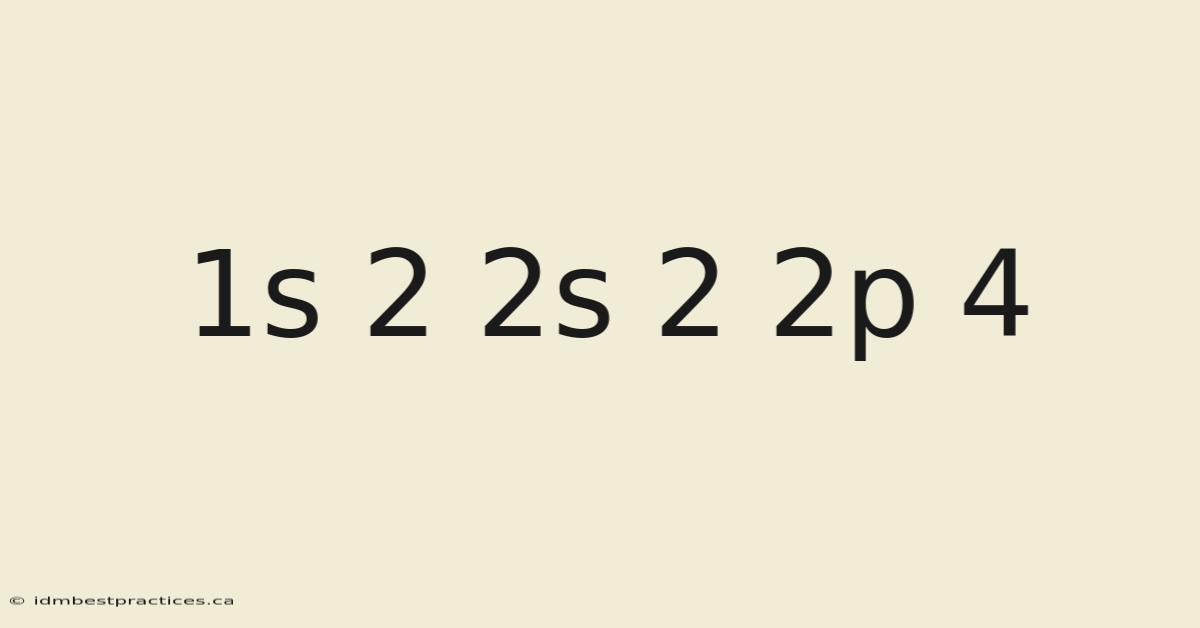
The notation 1s 2 2s 2 2p 4 represents one of the most fundamental blueprints in chemistry: the ground-state electron configuration of an oxygen atom. That's why understanding this arrangement unlocks the secrets of chemical bonding, reactivity, and the very behavior of matter. At first glance, it may look like a random string of numbers and letters, but each component reveals how electrons are arranged around an atomic nucleus. Whether you are a student navigating introductory chemistry or a curious learner exploring atomic structure, mastering how to read and interpret 1s 2 2s 2 2p 4 will transform abstract quantum concepts into practical, everyday scientific knowledge.
Introduction
Chemistry often feels like a foreign language until you learn its alphabet. Electron configuration serves as that alphabet, providing a standardized way to describe where electrons live within an atom. The sequence 1s 2 2s 2 2p 4 is not merely a memorization exercise; it is a direct reflection of quantum mechanical reality. Every element on the periodic table has a unique electron arrangement that dictates its physical properties, chemical behavior, and role in the universe. Oxygen, with eight protons and eight electrons in its neutral state, follows a predictable filling pattern that scientists have mapped through decades of spectroscopic research. By examining this specific configuration, you gain insight into why oxygen supports combustion, enables respiration, and forms the backbone of countless organic molecules. The journey from raw notation to chemical understanding begins with breaking down each symbol, understanding the rules that govern electron placement, and recognizing how these microscopic arrangements shape macroscopic phenomena.
Steps
Reading electron configuration becomes straightforward when you follow a systematic approach. Each segment of 1s 2 2s 2 2p 4 carries specific information about energy levels, orbital shapes, and electron counts. Follow these steps to decode the notation accurately:
- Identify the principal quantum number: The first digit in each group (1, 2, 2) represents the main energy shell. Lower numbers indicate electrons closer to the nucleus with lower energy.
- Recognize the subshell type: The letters (s, s, p) describe the orbital shape. The s subshell is spherical, while the p subshell consists of three dumbbell-shaped orbitals oriented along perpendicular axes.
- Count the electrons: The final number in each group (2, 2, 4) shows how many electrons occupy that specific subshell. Adding them together (2 + 2 + 4) gives you eight electrons, confirming the element is oxygen.
- Verify the filling order: Electrons always occupy the lowest available energy state first. The 1s orbital fills before 2s, and 2s fills before 2p, following a predictable energy staircase.
- Check orbital capacity: An s subshell holds a maximum of two electrons, while a p subshell can accommodate up to six. The notation 2p 4 indicates the subshell is partially filled, leaving room for two more electrons to achieve stability. Practicing these steps with other elements reinforces pattern recognition. Once you internalize the relationship between numbers, letters, and electron counts, reading configurations becomes as natural as reading a sentence.
Scientific Explanation
The arrangement described by 1s 2 2s 2 2p 4 is governed by three foundational principles of quantum mechanics that dictate how electrons distribute themselves in space. First, the Aufbau principle states that electrons fill orbitals in order of increasing energy. This explains why the 1s orbital completes before any electrons enter the second shell. Second, the Pauli exclusion principle ensures that no two electrons in an atom share identical quantum states. In practical terms, this means each orbital can hold a maximum of two electrons with opposite spins, often visualized as one spinning clockwise and the other counterclockwise. Third, Hund’s rule addresses how electrons populate degenerate orbitals, which are orbitals of equal energy like the three 2p orbitals. According to this rule, electrons will occupy each available orbital singly before pairing up. This minimizes electrostatic repulsion and maximizes atomic stability. When applied to the 2p 4 segment, Hund’s rule reveals that two of the three 2p orbitals contain one electron each, while the third holds a paired set. These two unpaired electrons are chemically significant. They create a magnetic moment, increase reactivity, and drive oxygen’s tendency to form covalent bonds. The energy difference between the 2s and 2p subshells, though small, creates distinct chemical behavior that separates elements across the periodic table. Spectroscopic experiments have repeatedly confirmed these arrangements by measuring the precise wavelengths of light absorbed or emitted when electrons transition between energy levels. Modern computational chemistry further validates these configurations by solving the Schrödinger equation for multi-electron systems, proving that 1s 2 2s 2 2p 4 is not just a theoretical model but a measurable physical reality.
For more on this topic, read our article on world map of the north pole or check out which way should ceiling fan go in winter.
FAQ
What element corresponds to 1s 2 2s 2 2p 4?
This configuration represents a neutral oxygen atom. The total electron count of eight matches oxygen’s atomic number, placing it in group 16 and period 2 of the periodic table.
Why is the notation sometimes written with superscripts?
Both formats are correct. The superscript version (1s² 2s² 2p⁴) is standard in academic publishing, while the spaced version (1s 2 2s 2 2p 4) is commonly used in plain-text environments, digital platforms, and introductory textbooks for improved readability.
Can this electron configuration change under different conditions?
Yes. When oxygen gains two electrons, it becomes an oxide ion (O²⁻) with the configuration 1s 2 2s 2 2p 6, achieving a stable noble gas arrangement. In high-energy environments, electrons may temporarily occupy excited states, but they rapidly return to the ground state configuration.
How does this configuration explain oxygen’s high electronegativity?
With six valence electrons in the second shell, oxygen is only two electrons away from a complete octet. This electron deficiency creates a strong pull on shared electrons during bonding, making oxygen highly electronegative and chemically active.
What comes after the 2p subshell in the filling order?
Once the 2p subshell reaches capacity at six electrons, the next available orbital is 3s. The filling sequence continues according to the n + l rule, which prioritizes orbitals with the lowest combined principal and azimuthal quantum numbers.
Conclusion
The sequence 1s 2 2s 2 2p 4 may appear as a simple arrangement of characters, but it encapsulates the quantum architecture of one of Earth’s most essential elements. By understanding how electrons occupy orbitals, follow filling rules, and influence chemical behavior, you gain a powerful framework for interpreting molecular bonding, reaction mechanisms, and material properties. Mastering electron configurations transforms abstract theory into practical insight, empowering you to predict how atoms will interact in both laboratory experiments and natural environments. As you continue exploring chemistry, remember that every combustion reaction, every biological process, and every synthesized compound traces back to these fundamental electron arrangements. Keep practicing, stay curious, and let the elegant logic of atomic structure guide your scientific journey.
Latest Posts
Related Posts
Covering Similar Ground
-
Which Statement Is Always True
Aug 08, 2026
-
Which Statement Is Always True According To Vsepr Theory
Aug 08, 2026
-
Which Statement Is Always True When Describing Sex Linked Inheritance
Aug 08, 2026
-
Which Statement Is An Accurate Description Of Genes
Aug 08, 2026
-
Which Statement Is An Example Of A Central Idea
Aug 08, 2026
